Engineering a Vercel Chat Adapter
How we built our open source Vercel Chat SDK adapter
AI agents communicate through channels like Slack, chat apps, and SMS. Most of these channels are ephemeral. Messages disappear into feeds, threads get buried, and there's no real record of what happened.
Email is the one protocol that nearly everyone already uses, and conversations don't vanish. We built the official Resend adapter for Vercel Chat SDK to bring email into the Chat SDK ecosystem.
Along the way, we faced challenges and made decisions and tradeoffs. Let's talk about the development process behind @resend/chat-sdk-adapter.
About the adapter
Vercel's Chat SDK is an open-source, TypeScript SDK for building chat bots across Slack, Microsoft Teams, Google Chat, Discord, and more. Write your bot logic once and deploy everywhere.
The Resend adapter extends the SDK, bringing email capabilities to your chat apps.
The Resend adapter treats email as a bidirectional chat channel. Inbound emails arrive via Resend webhooks and trigger Chat SDK event handlers. Outbound messages get delivered as emails through the Resend API.
Practically, this means that you can send emails from your chat interface, build proactive outbound notifications, and more.
Threading without a database
Chat platforms give you thread IDs for free. A message arrives on Slack with a thread_ts. Discord has channel IDs.
Email doesn't work like that. There is no central thread ID, so threading is a client-side concern.
There are two headers that let mail clients reconstruct conversation threads: In-Reply-To and References. These require Message-IDs of prior emails to keep track of the thread. We needed to derive thread IDs from email headers alone. The format we chose looks like this:
resend:{sender-address}:{sha256-first-16-chars-of-root-message-id}
When a new email arrives, the ThreadResolver checks whether In-Reply-To or References point to a message we've already seen. If so, it's part of an existing thread. If not, we hash the Message-ID to create a new thread ID.
async resolveThreadId(input: ResolveInput): Promise<string> {const { toAddress, messageId, inReplyTo, references } = input;if (inReplyTo || references) {const candidateIds = this.extractMessageIds(inReplyTo, references);for (const candidate of candidateIds) {const existingThread = this.messageToThread.get(candidate);if (existingThread) {this.trackMessage(existingThread, messageId);return existingThread;}}}const hash = await hashMessageId(messageId);const threadId = this.encodeThreadId({ toAddress, rootMessageIdHash: hash });this.trackMessage(threadId, messageId);return threadId;}
An in-memory Map is enough here. Email already carries its own history in the References header, so we don't need persistence. As long as the adapter process is running, it can track which messages belong to which threads.
Mapping between email and chat
The Chat SDK expects adapters to implement parseMessage (inbound) and postMessage (outbound). Both have specific shapes.
On the inbound side, the SDK wants a Message with an author that has userId, userName, and isMe values. For email, the identity fields are the sender's address. isMe is true if the sender matches the bot's fromAddress.
On the outbound side, postMessage accepts an AdapterPostableMessage. This is a union that can be a plain string, markdown, an AST, or a structured card. Each needs to become an email with HTML and plain text options. Strings and markdown are straightforward. Cards are not.
Rendering cards as email
The Chat SDK has a CardElement type for structured messages: cards with titles, sections, fields, buttons, images, dividers. We had to turn them into email HTML.
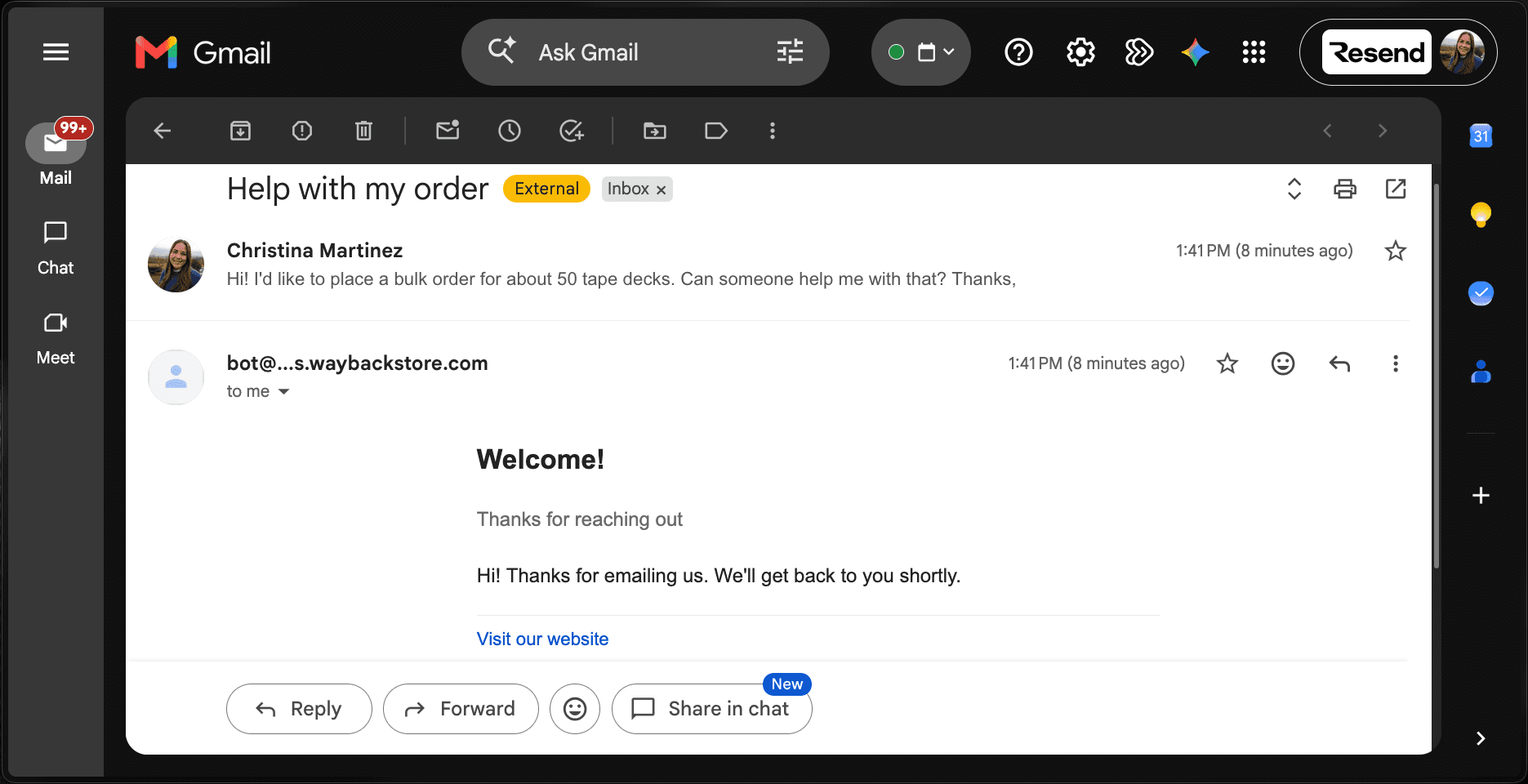
To accomplish this, we turned to our open source package, React Email.
Each CardElement type maps to a React Email component:
- Text (with a content property) becomes
<Text> - Field (with label and value) becomes a bolded label and a value
- Link-button (with label and url) becomes
<Button> - Image (with label and url) becomes
<Img> - Divider becomes
<Hr />
What I learned
The bulk of the work when building the Chat SDK adapter was translation. Each platform has its own version of threads, messages, authors, and some form of rich content. The work is figuring out how platforms represent those things differently and writing the conversion layer.
Email's representations are older and less convenient than all the other platforms. You have to reconstruct a thread from headers alone. No structured content format exists; you need to render archaic email HTML.
But email reaches everyone. There's no OAuth, no app installations, and no workspace invites. You simply send to an address and they receive it. It's the democratic protocol that the web was built on.
We're excited to see what you build with the Resend adapter. Check the docs for the full setup guide, or view the open source code.